
Exploring the Future of Architectural Education Through HBIM Innovation
Brandon Roberts, Technical Demonstrator in Architecture at the University of Wales Trinity Saint David (UWTSD), is helping to shape conversations about how digital skills are transforming architectural education.

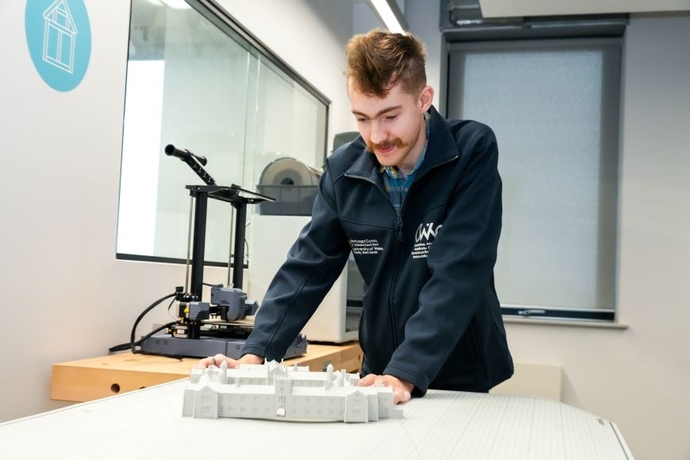
Brandon presented his talk, “Learning HBIM - A Necessary Addition to Architectural Education?,” at the Building Information Modelling (BIM) Conference in Leicester, which brings together specialists, architects, and designers. His presentation was based on an innovative UWTSD project to create a detailed digital model, or “digital twin,” of the University’s historic St David’s Building.
HBIM (Heritage Building Information Modelling) is a specialist application focused on existing and historic structures, rather than new-build projects. In his talk, Brandon described HBIM as “a library in which every detail about the existing built form can be described.” In practice, this means creating a comprehensive digital twin that captures everything from the building’s physical fabric, including walls and intricate architectural features, to detailed technical information such as condition reports and the age and performance of individual elements, including windows and fittings.
The St David’s Building was designed between 1822 and 1827 by renowned architect Charles Robert Cockerell in a simplified Tudor Gothic style.
With Brandon’s technical leadership, the project aimed to create an accurate digital version of the building to support UWTSD’s estates team with future maintenance and planning. The model allows building features, such as lighting and other key elements, to be clearly mapped and recorded, helping the University care for the building more efficiently and sustainably.
Using a Leica RTC360 scanner, Brandon and the team captured millions of measurements of the building. This data was developed into a working 3D model using Autodesk Revit and later brought into Twinmotion, allowing it to be explored in Virtual Reality.
A key focus of Brandon’s talk was the value of involving students directly in the project. By working on a historic building, students gained practical experience in digital surveying, 3D modelling and understanding how older buildings can be maintained and adapted for the future.
Rather than learning solely in the classroom, students were able to apply their skills in a live environment, preparing them for a profession that is increasingly reliant on digital tools and more sustainable approaches to managing buildings.
Brandon emphasised that working with existing buildings is especially important, as much of the construction industry’s future lies in improving and adapting what already exists rather than building new.
He said: “This project shows how powerful it can be when education and real-world practice come together. By creating a digital model of the building, we’re not only helping the University look after an important part of its history, but we’re also giving students hands-on experience with the tools and ways of thinking that are shaping the future of architecture.
“Digital skills are no longer a bonus in our industry, they’re essential. Giving students the opportunity to work on a live heritage project helps them understand both the responsibility of caring for historic buildings and the role technology can play in making that process smarter and more sustainable.”
Through his work, Brandon Roberts is helping ensure that UWTSD architecture students graduate with the practical skills, confidence and forward-thinking mindset needed for a rapidly evolving built environment sector.
Further Information
Rebecca Davies
Executive Press and Media Relations Officer
Corporate Communications and PR
Email: rebecca.davies@uwtsd.ac.uk
Phone: 07384 467071