
New research highlights opportunities to embed children’s participation in Welsh teacher education
Researchers from the Children’s Participation in Schools Project, a collaborative initiative funded by the Economic and Social Research Council (ESRC), have published the Phase 3 findings of their national study, revealing that while the Welsh Government’s Curriculum for Wales strongly supports children’s participative rights, Initial Teacher Education (ITE) programmes could embed participation more consistently in everyday classroom practice.

The project brings together expertise from the University of Wales Trinity Saint David (UWTSD), University of the West of England (UWE), Swansea University, and Cardiff Metropolitan University. Its primary focus is to explore and promote the participative rights of young children within lower primary education settings in Wales (3–7-year-olds).
Phase 3 of the project focused specifically on ITE provision in Wales and followed on from the project’s earlier nationwide survey of ITE providers. Over a 12-month period, researchers worked closely with ITE students and teacher educators through an enquiry-based programme of focus groups and workshops to explore how children’s participative rights are understood and enacted in teacher education .
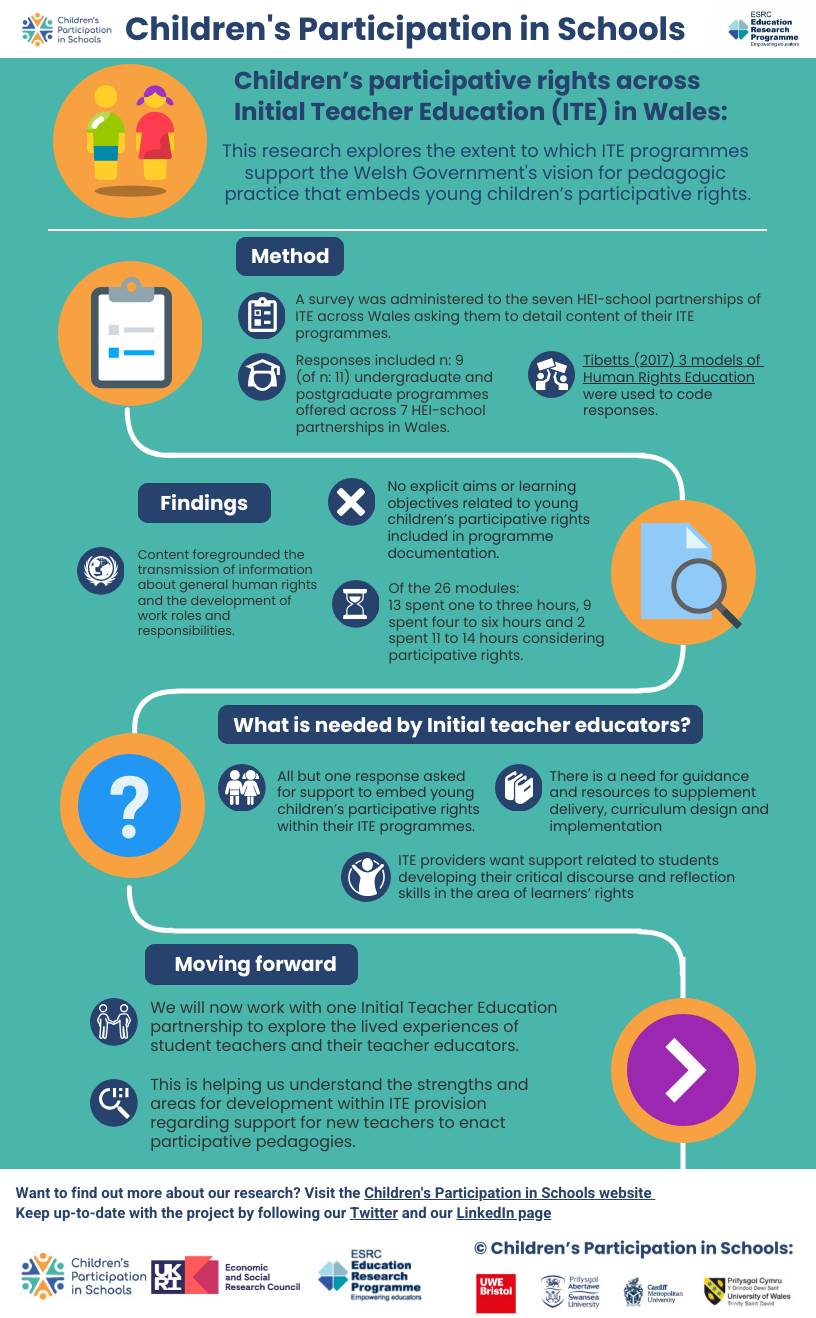
The new findings highlight that, despite the Curriculum for Wales’ expectation that pupils learn ‘about’, ‘through’ and ‘for’ human rights, ITE students most commonly encounter participation through formal models such as school councils and eco-committees, rather than through participatory pedagogies embedded in everyday classroom decision-making.
Researchers also identified opportunities for both ITE students and school pupils to develop and experience authentic participation.
UWTSD’s Dr Jane Waters-Davies said:
“We are excited to be highlighting the findings of phase 3 of the Children’s Participation in Schools Project, focused on Initial Teacher Education (ITE) in Wales. Following our earlier nationwide survey of ITE providers we spent a year engaging in enquiry-based research into ITE provision and how it may support children’s participation in the classroom. We found that, though this aspect of pedagogy can be overlooked in ITE provision, there are many opportunities to embed participation both in university-based and school-based elements of the programmes.
“There are professional learning implications for teacher educators inherent in optimising such opportunities. Since children’s participation is fundamental to the vision embedded within the Curriculum for Wales, we hope that this research can be used to support effective curriculum realisation in which children’s participative rights are routinely embedded in participatory pedagogic practice.”
The Phase 3 policy briefing, Initial Teacher Education and Children’s Participation: Missed opportunities, what we are [not] telling our student teachers, builds on the project’s earlier phases, which examined children’s participation across schools in Wales more broadly. It also sets out a series of recommendations aimed at strengthening participatory pedagogies across ITE including calling on Welsh Government to ensure that there is professional learning and guidance available for ITE providers to supplement and/or reframe ITE programme curricula to optimise children’s participation in the classroom.
Researchers hope the findings will inform future ITE programme development, professional learning for teacher educators, and policy discussions around children’s rights and democratic participation in education.
The full Phase 3 policy briefing is available here:

Further Information
Arwel Lloyd
Principal PR and Communications Officer
Corporate Communications and PR
Email: arwel.lloyd@uwtsd.ac.uk
Phone: 07384 467076