
Foundation Art and Design

GENERATE
To generate, in its simplest sense, means to produce or bring something into existence. Unlike traditional ideas of making, generation often implies that something emerges through a system, process or interaction rather than through direct authorship.
This year’s Foundation students have investigated our show’s title through processes that discuss - Artifical Intelligence, the production of energy, cloning, generating culture through remixing, chance operations, instructions, repetition and cycles of repair and renewal. Today, generation sits at the centre of urgent cultural debate, systems can now generate images, music, writing and even identities - raising questions around labour, authorship and ownership.
Foundation welcome you to their show and the staff team wish the students the best of luck in their future destinations.
Class of '26
Our Work
Perspective and Perception Are you looking? I’m watching you. Do you judge people on their hair, clothes, accent, weight, skin colour, differences, or similarities? Our perspective is generated from a culmination of all our experiences and senses. Our senses can be deluded by various factors such as ill health, lighting, noise levels, and altered states of consciousness. Therefore, it is a reasonable assumption that every person’s perception and perspective are unique. The piece I have chosen is a simple, cartoon-like animation to invoke memories of a child’s innocence and curiosity, before life has ‘impacted’ them. Much like Keith Haring’s artwork in New York, I hope to use the playful imagery to bring art to the wider community. With this in mind, there are interactive pieces to ‘play’ with.

‘Generate’ means to produce or create something through a process or system. For ‘generate’, I created a series of AI-constructed portraits and landscapes using artificial intelligence, as a means to manipulate the image, creating glitch and colour variation.
The work was inspired by the work of Andy Warhol who explored mechanical reproduction and repetition through screen print process. Alongside this, the idea of instruction - based method as evident in the work of Sol Lewitt has been considered. This enabled me to then consider the work of Relik Anadol who uses data machine learning to generate the visual environments.

Artemis
Theme: The Intersection of Motion and Anti-gravity
This work is a sensory journey where the laws of physics meet the poetry of motion. Rooted in the traditions of Kinetic and Land Art, Artemis emerges from personal experiences with nature and space. At its centre is an organic wicker structure — a material that grounds the piece in the earth even as it seeks to escape it. As the observer moves through the installation, subtle vibrations awaken a chorus of bells while the central figure — reminiscent of a weightless astronaut — begins to sway in perpetual levitation. The final form of Artemis draws from Richard Long, Slawomir Brzoska, Alexander Calder’s mobiles, and the wind-swept mechanics of Theo Jansen’s Strandbeests. Here, gravity is no longer a force, but a memory.

We share the air with the woods and the water with the seas.
Like a body, they and we are one. (Buddha)
Generate asserts this unity, as body and nature continuously create, dissolve, and regenerate in cycles of growth and decay. The changing seasons bring comfort in the face of our mortality. My body is central to my artistic creation, as I explore through paint, dance, or photography. Inspired by Mendieta’s Siluetas, my nude form is merged into natural elements, through digital layering, to express the shared life force connecting us to the universe.

I aspire to create sculpture that explores nature and its decline. Some of my interests come from exploring prehistoric objects such as the goddess and the concepts of why they were made, I am also interested in a wide range of artists and their work. By sculpting I wish to echo these ideas and symbolism by using natural materials, such as clay, plants and the occasional found object.

This project explores cultural identity, historical narrative, and future accountability through a personal and research-led lens. It reflects on experiences of activism, including a hunger strike in 2004, and examines how these moments continue to inform my interest in educational research, collective memory, and social responsibility in Cymru. The work forms part of the developing project Red Book of Cymru (Education Lesson: Part 1). Using accountably retained materials — including remnants of a piano, layered acetate, and ‘Evolvic’ archival elements — I construct a visual and conceptual framework that moves from chaos toward reflection, World-Cymru-Knowledge, dignity, and responsibility. The installation questions how history is presented through education and why it is vital for contemporary generations to engage more critically and accountably with inherited narratives.

My response to the theme ‘generate’ is very literal. My piece will generate motion as well as distorted images through reflections. I am using 3D mechanical motion in order to generate distorted reflections through a 3D-printed gear mechanism on top of a wooden base. My piece has been influenced by the mechanical workings of Jean Tinguely as well as the aesthetic aspect of Spy “24 mirrors”.

For ‘generate’, my aim has been to develop a range of experimental works that reflect me as an artist. I enjoy working with both analogue and digital process, to make physical pieces and digital illustrations. For this project, I have combined textiles and acrylic, exploring tapestry, crafting with clay and making garments in textiles. I took inspiration from a range of references - the game Psychopomp, my favourite childhood game Little Big Planet, and Luned Rhys Parris’s Work.

Because no hope means hope
Loving without expectation is highly underrated. Many of us are living ‘fake’ lives, especially on social media. What if we remove transactional pressure allowing love to become an authentic experience? ‘Because no hope means hope’ includes 3D collage, paintings and inspirational quotes of Walter Benjamin to explore this idea. The process of making including using materials of everyday life, like newspapers, fabrics and found objects, involving a process of transforming the mundane into new narrative.

Detect, Extract, Process
For ‘generate’ I responded to the idea of ‘deepfake’ accumulating AI images of people. I considered the divided arguments ‘for or against’ the technology but concentrated on the technological possibilities. I found common wording, ‘Detection, Extraction, Processing’ this sparked an idea of material play and reimagining. As a mixed media artist, I combined several different techniques to create these electronic styled pieces, turning virtual concepts into tangible outcomes. By repurposing old technologies, I believe it highlights the constant development of this industry.

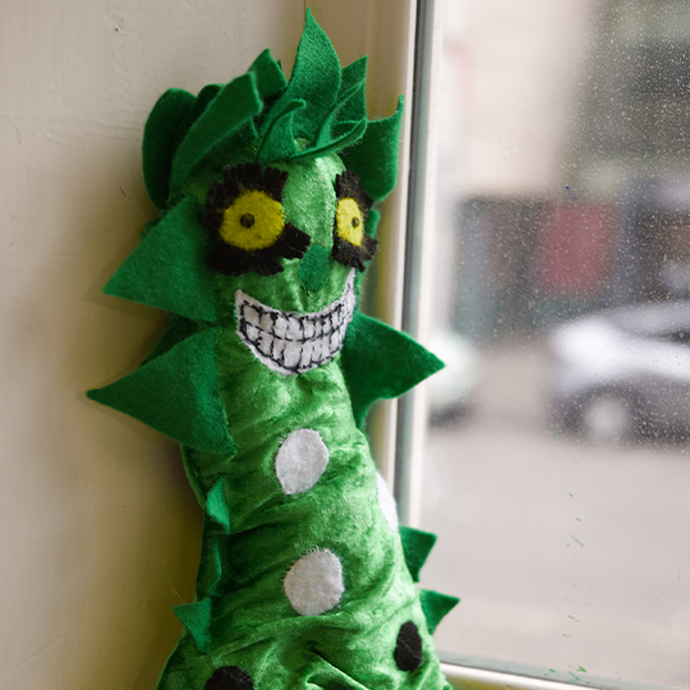
My response to the word ‘generate’ was initiated by an interest in colour symbolism. I related this to song lyrics, and character ideas started to flow. The expression ‘Red with Rage’ prompted ideas for a Chinese dragon. I began to draw a dragon on the paper with parasols, to use watercolour and combine the style of Pointillism into my illustrative painting, then extending this experimentation to make a Chinese Dragon puppet. I developed characters such as ‘Gerry the Green–Eyed Monster’, experimenting with fabrics and felt for the design. I have been influenced by the literature and illustrations of Beatrix Potter. She was my catalyst for a career in illustration. I have also been inspired by Georges Seurat for his pointillism style.
This piece explores the theme “generate” quite literally, combining the inconsistencies found within AI generated content with a subject which AI cannot replicate, feeling affection. I used mixed media, primarily acrylic paint and oil pastels. I have also made use of textural elements such as candle wax, buttons, and textiles, to explore a feeling of fondness and longing. This piece has been visually inspired by paintings by Benjamin Björklund, Hunt Slonem, and other impressionist artists. My work is also largely inspired by feminist and politically outspoken artists.

For ‘generate’ my initial thoughts related to cognition. I thought about how we evoke words and images in our minds daily, and how these generate shifting, evolving memories of the past. Working on MDF board with oil paint, I experiment with space, surface, and layering, using blurred and overlapping imagery to reflect the unpredictability and ambiguity of thought. The aim is to create a landscape based on childhood experiences and the hidden stories within them. Focusing on childhood helps me come to terms with new responsibilities and confront fears about the future, while also exploring nostalgia, curiosity, and adventure. I was particularly inspired by Sue Williams’ work, combining rough paint marks with vivid colours to creating fragmented reflection through space and composition.

Placenta: Generating Connection ‘Generate’ is a continuous process of birth, regeneration and transformation. My work reflects life as an ongoing flow, reconnecting us with its vital, sustaining source. I create circular cushions from red wool and linen, connected by umbilical forms and roots. A woven textile represents Mother Earth, while sound meditation invites embodied reconnection with life’s energy. I am inspired by Sheila Hicks’s approach to weaving as thinking, and Andy Goldsworthy’s organic land art exploring nature, cycles and inner reflection.

‘Generate’ – to create; to produce, it could be something from scratch, utilising something second hand, working with previous concepts or ideas, something tangible or intangible, a thing or a thought. For this work, I am using mixed media - a combination of new, second-hand textiles, and recycled materials with stitch to make experimental drawings and paintings. The intention is to transmit messages with the hope it could help us as a society, to help the environment, and to share part of my heritage. My influences are Snoop Dogg, Nory Flores, Fernando Llort, Tilleke Schwarz, Henri Mattise, Vincent Van Gogh, Andy Warhol, Katherine Soucie, Picasso, my spiritual life, my family, my friends, Mother Nature, the community, my teachers, and classmates. A special thank you to all of you.

To respond to ‘generate’ I was inspired by the concept of cloning and the constant generation of mushrooms and the mycelium network, especially the largest single organism by mass, the “Humongous Fungus”, which covers 2,385 acres. It is impossible to eliminate all mushrooms globally, and this fascinates me as an organism that can only grow in nature. My artistic influences came from Keith Haring’s use of repetition and bold outlines, and Barry Reigate’s ‘Great Expectation’, with his chaotic, overlapping forms and expressive characters. My aim was to create a mural where multiple mushrooms appear separate but function as one continuous, growing organism.

For ‘generate’ I have focused on the power concept within politics and personal relations, its arbitrary impacts both globally and individually. I have utilised various print making processes together with collage to explore the hypocrisy of war, political branding and relational narcissism. I have been influenced by John Heartfield’s and Peter Kennard’s photomontage, and El Lissitzky and Mel Bochner’s graphic work.

In response to the theme ‘generate’; I created a collection of intricate pieces of paper art to explore the world of my graphic novel “The Adventures of Blodyn Tatws” in a different medium. I used a variety of techniques such as using paper quilling and colouring, cutting out and layering paper to make intricate pieces of artwork. I want my art to show people the small details that life has to offer that would otherwise go unnoticed. The artists that inspired me to create paper art are Tania Lissova making her intricate flower paper art and Julia Yus with her creative pop-up art.

My work is generated from the concept of the imagery of oppression and how it is expressed. My aim is to engage the viewer and hope that they are intrigued enough to question what I am portraying. Many artists use shoes or boots to tell stories of hardship, loss, absence or death such as Van Gogh, Francis Alÿs and Elina Chauvet. In my pieces I have looked at oppression through aggression, pageant, invasion and bullying, seeking to question what has become the norm and highlighting its impact on society.

Through ‘generate’ I have explored how ideas emerge through transformation, repetition, and experimentation. I have explored new forms, meanings, and allowed narratives to surface through active making and re‑making through the quiet momentum of stitching. I have generated new work by transforming reclaimed, recycled and charity‑shop textiles. Through cutting, stitching and reworking, I create forms that emerge from sustainable making and continual experimentation. Bispo do Rosário’s devotional textiles and Grayson Perry’s layered narratives guide me to generate work from humble materials, creating stitched stories shaped by memory, humour and lived experience.

My work explores the biological process of regeneration, working with the salamander as my central design aesthetic because of their remarkable ability to regenerate entirely new organs. Conceptually the work delves into the metamorphosis of wearable garments transforming into salamanders, working with faux leather to resemble amphibian skin. The tails have been proliferated as though they’ve gone into regenerative overdrive - escalating out of control. Working with scale and bold colours, the work creates a visually overbearing display that intends to break boundaries between it and the audience. A significant influence has been Monster Chetwynd because of her absurd spectacles that include performative costume and monstrous installation, exploring themes of self-transformation and ‘becoming other’, greatly resonating with my own practice.

For ‘generate’, I am focusing on the gesture of grabbing the stomach repeatedly, using film as a medium to create cinematic atmosphere, capturing up close and intimate detail, whilst slowing down the image. The aim was to attract the viewers full attention so that they are focused and attentive, provoking a sense of uneasiness, curiosity, and voyeurism in the viewer. I was inspired by Tony Blanc’s use of self-portrait photography, captured in black and white film, and Andy Warhol’s ‘8-hour long Film Empire State Building.
Energy Vortex
Energy is all around, it consumes us and we consume it. It’s not just about electricity but the spiritual energy fields we create. Energy Vortex represents the intangible constructs of the energy that surrounds us physically and emotionally. In this work I have used 3D sculpture and the power of light. My decision to incorporate electrical installation into my art has stemmed from my research into artists such as Haroon Mirza, Dan Flavin and Nancy Holt who all play with themes of electricity and energy within their practice.

The theme ‘generate’ inspired my idea for creating abstract jellyfish forms. For these sculptures, I combined welded metal with free - flowing textured fabric. I wanted to play with contrast, spot welding each sharp corner of the black wire frame, then draping the soft dainty fabric over to capture the jellyfish’s natural free movement as it swims through the ocean. The harshness of the wire frame captures the structured, almost mechanical inner workings of life, while the fabric represents the freedom of movement. I chose to use the image of a jellyfish for this concept as their movement through the ocean looks chaotic but is rather beautiful too.

Hunger
For the theme ‘generate’ I considered how each of us generate and bear emotions. Hedonist Hunger is a specific condition which can represent how intense psychological feelings can intensify. For this work I have utilised sculpture and audio.
The audio piece includes sampled processional elements with original instrumentation. The sculpture is a visceral expression of hedonistic hunger combining fabric, paint, glue and petroleum jelly. I was inspired by musicians Bjork and Yuele for their electronic arrangements, and Eva Fabregas’s sculptural practice.

The theme ‘generate’ allowed me to have the freedom to bring something into existence and be creative. For this, I have used a pencil to capture detail – a family portrait within my siblings. This image implies emotions revealing their individual personal traits. I have applied colour to express the love and joy that runs through. Amanda Oleanders work has inspired because of her focuses on the private moments with friends and family; those moments which are usually hidden from the public eye.

The process of ‘generating’ a piece of work is different for every artist, something that is uniquely human about art, and cannot be truly replicated by generative AI. This piece was made by breaking down the steps of making a traditional acrylic painting - sketching, gesso, base colours, and then details, shown layer by layer. I looked artists Refik Anadol, Karla Ortiz and Kelly McKernan.

The theme ‘generate’ inspired me to consider the pro-active process of creating awareness, reflecting a desire to design a piece that is meaningful and powerful to yourself. For my piece, I have made an array of experimental large-scale fans through processes including spot welding, tetra pak print, etching and more. For these designs, I have created collages, which I have developed in Adobe Photoshop, before printing, cutting and constructing into the fan structure that they have become. I was inspired by western women getting tattoos – and the sense of rebellion, empowerment and reclamation of the body that this represents. Artists who have been particularly influential include Jessie knight and Miriam Schapiro.

For ‘generate’, I have decided to utilise works which engage with the art historical traditions of Christian imagery, especially that which is generated for modern churches. I hope that the works raise questions about the place of religion and religious culture in our modern society. My practice encompasses a wide variety of mediums including ceramics, painting and printing. I have chosen to incorporate several small objects into a shrine-like arrangement. My work has been influenced by my many visits to churches and heritage sites - and the artists whose work I have seen there. This included Jacob Epstein and Eric Gill. The work also draws influence from the traditions of subverting Christian imagery in a fine art context, including the artists Ciprian Muresan, Max Ernst, and Claire Curneen.

An artist’s life is spent generating work. The body is a muse found throughout history. This piece is an admiration for the true foundation of art: our bodies. This work uses a mix of spot welding, sewing, and felting. With these processes, I have further twisted, woven, and stabbed the material, in an animalistic manner. I was inspired by the artist Do Ho Suh, who uses a similar mix of metal and semi-transparent fabric, to connect the audience to the mundane, and overlooked.

Through the theme ‘generate’ I have explored femininity and identity to question how we are shaped by roles. I have created an installation of shells filled with resin, glitter and flowers to represent individuality. Arranged in a spiral, they lead to a single broken shell, symbolising the soul’s journey beyond the physical body. Alongside this, my photomontages explore domestic roles, opposing ideologies and expectations placed on women. I was inspired by artists Linder Sterling, and Hannah Höch, particularly their use of photomontage to question how women are seen, shaped, and expected to behave.

I am responding to the theme of ‘generate’ by exploring how ideas evolve through making, using fabric to express growth, change, and personal experience. I am creating a garment that combines experimental stitching and layered textiles, allowing the piece to develop organically as I respond to materials and process. My work is influenced by contemporary textile artists and designers who embrace imperfection and process, including Rei Kawakubo for Comme de Garcon as my own experiences, which shape the narrative and emotional direction of the piece.

I generated a music video response to ‘Jump Up and Down’ by Swansea band Helen Love, combining fun, and maximalist visuals capturing moments from Foundation Art & Design, my first year at university. I used filming, collage materials (stickers, magazine cutouts, etc), editing effects (photo filters, cartoon fonts, animations) and past photos/videos to express the song’s energetic bubblegum pop sound, whilst simultaneously using self-expression as a tool for storytelling. My artistic influences for this work include Peter Blake, Helen Love’s album covers and some Kero Kero Bonito music videos.
For ‘Generate’, I first explored the etymology of the word — to regenerate, repurpose, and adapt an existing idea into something new. This project involved recreating Boba Fett’s costume as seen in The Mandalorian Season 2, Episode 6. Through experimentation, I explored new ways to develop the costume while remaining true to the original design. Using mixed media including 3D printing, sewing, painting, grout texturing, and graphite powder finishes, I combined processes learned from previous projects with new techniques to elevate the work. My main influence was Legacy Effects, the team who reinvented the original costume design created by ILM in the 1980s, balancing innovation with homage to the character’s history.

In response to the theme ‘generate’ I used methods of visual development to iterate character designs. For this I have created a circus-themed cast of puppets. I drew paper puppet bases and hand painted them. I used split-pins to assemble the different parts and have displayed them with string onto my cardboard base. My influences were artists Alexander Girard for his family of wooden dolls, and Alexander Calder and his piece ‘Calder’s Circus’.

For me, ‘generate’ meant creating multiple responses. Each response reflects a date in which (what I consider to be) a life-changing event transpired. I have worked with a variety of materials and processes that align with the context of the date each piece is centred around. I have been particularly inspired by On Kuwara and his ‘date paintings’. I also took influence from the layout of Rene Magritte’s ‘The Treachery of Images’.

Exhibition Gallery


